
Comparison
Canny vs UserVoice: Pricing, Setup and Who Each One Fits
Canny is self-serve, priced by tracked users, with a Free plan. UserVoice is bought through a demo, with plans from $12,000 a year priced by admin seats. Both are as of November 2026. For a third option, see UserVoice vs FeatQ. Sources: Canny's pricing page and UserVoice's pricing page.
FeatQ is our product, so weigh our view of it accordingly.
On this page
The short answer
Canny and UserVoice are both customer feedback management platforms: a public feedback portal where customers submit ideas and vote, a roadmap, status updates, and tools for a product team to prioritize requests. They differ in who they are built for and how you buy them.
- Canny's bill follows your audience. It counts tracked users, the people who post, vote or comment, and includes a set number of manager accounts per plan.
- UserVoice's bill follows your internal team. It counts admins, with unlimited portal users and unlimited view-only admins on every plan.
- The buying path differs. Canny is self-serve with a Free plan. Every UserVoice plan starts with "Book a demo".
A startup or SaaS team that wants a voting board this week, with Linear or GitHub on the product side, will usually find Canny the easier choice. An enterprise company that wants Salesforce, HubSpot and Gainsight data behind every idea, guided onboarding and many internal admins will find UserVoice built for that.
How each one charges
Canny: tracked users, in tiers. As of November 2026, the Canny pricing page lists Free, Pro and Business. Free covers 25 tracked users with no time limit. Pro starts at $79 a month billed yearly, or $99 billed monthly per Canny's billing plans article, for 100 tracked users, and climbs to $1,079 a month billed yearly ($1,349 monthly) at 5,000. Business is a custom price above that. A tracked user is anybody with an attributed post, vote or comment, including feedback an admin or Canny's AI logged on their behalf. The count does not reset each month, and Canny upgrades you to the next tier automatically once you pass your limit, unless you set a monthly spend limit. Pro includes 10 manager accounts (Free has 5) and unlimited contributors.
UserVoice: admin seats, plus instances and add-ons. As of November 2026, UserVoice's pricing page lists Launch from $12,000 a year with 20 admins, Business from $22,000 a year with 50 admins, and a custom Enterprise plan. Extra admins are $40 a month each, billed yearly ($480 a year). An admin is someone who merges and labels feedback, updates statuses, replies to customers or changes settings. Feedback items, portal users and view-only admins are unlimited on every plan. The page adds that pricing depends on your admin seats, instances and add-ons: Launch is built for a single product or team, Business allows multiple instances, and Gainsight is an add-on on any plan.
The plan-by-plan detail is in Canny pricing for every tracked-user tier and UserVoice pricing with admins and add-ons, which also covers the plans UserVoice listed before it published these prices (in the version republished November 5, 2026).
What a team pays in year one
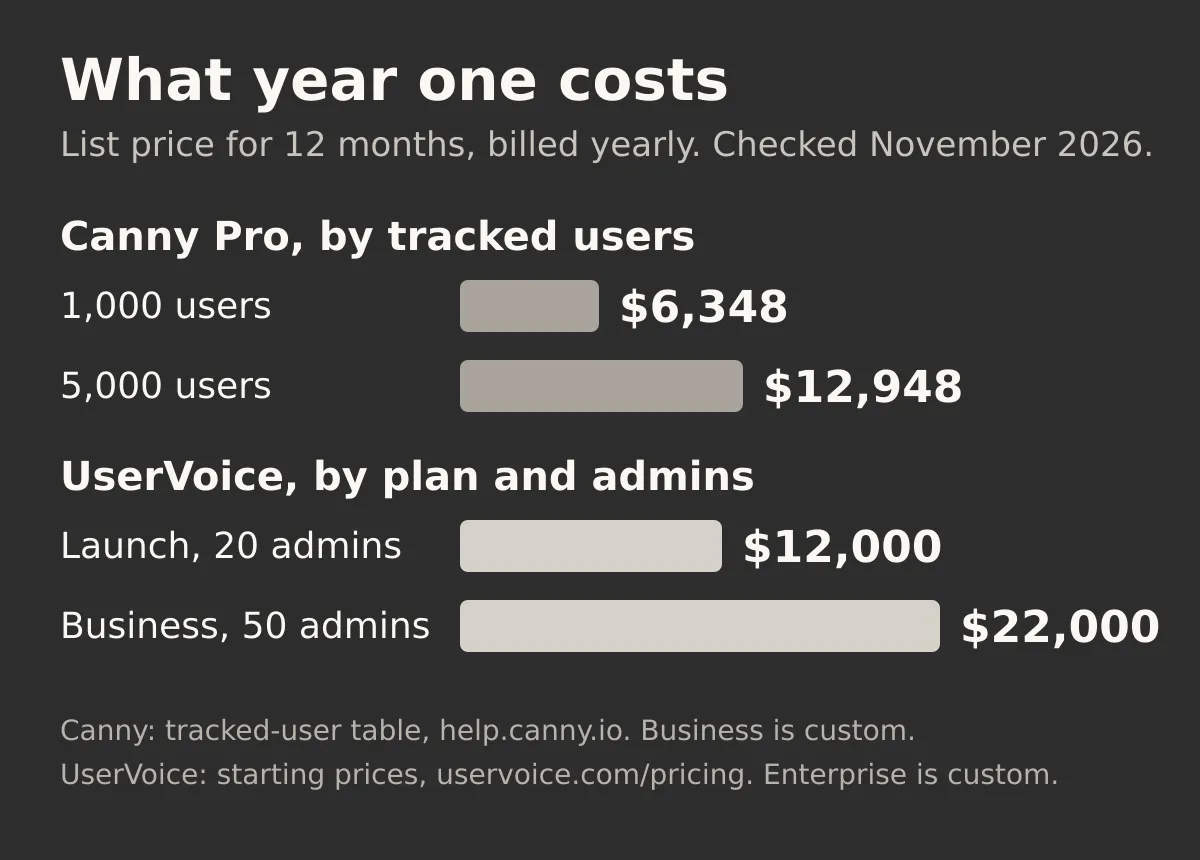
Assumptions: list prices billed yearly, as of November 2026, for 12 months. Canny rows count the people who posted, voted or commented. UserVoice rows count admins and use the starting price, which UserVoice says can change with instances and add-ons. No taxes, discounts or services.
| Plan | What it covers | Year one |
|---|---|---|
| Canny Free | Up to 25 tracked users, 5 managers | $0 |
| Canny Pro | 100 tracked users, 10 managers | $948 |
| Canny Pro | 1,000 tracked users, 10 managers | $6,348 |
| Canny Pro | 5,000 tracked users, 10 managers | $12,948 |
| Canny Business | Over 5,000 tracked users | Custom |
| UserVoice Launch | 20 admins, unlimited portal users | $12,000 |
| UserVoice Launch | 25 admins, unlimited portal users | $14,400 |
| UserVoice Business | 50 admins, unlimited portal users | $22,000 |
| UserVoice Enterprise | Admins and instances to fit | Custom |
How the rows are worked out: Canny Pro is the monthly price billed yearly times 12 ($529 x 12 = $6,348 at 1,000 tracked users). UserVoice Launch with 25 admins is the $12,000 starting price plus 5 extra admins at $40 a month for 12 months (5 x $40 x 12 = $2,400), so $14,400.
Three things stand out. Up to about a thousand tracked users, Canny costs about half of UserVoice's entry plan, or less. At 5,000 tracked users the two are close: Canny Pro is $12,948, Launch starts at $12,000. And inside UserVoice, admins decide the plan: at 41 admins, Launch would list at $22,080, above Business's $22,000 starting price, which already includes 50. Run it with your own numbers: your audience size for Canny, your admin count for UserVoice.
Setup and time to launch
Canny is self-serve. You sign up on its website, start on the Free plan with no time limit, and can try Pro or Business for 14 days with no credit card, per its trial article (as of November 2026). On Free and Pro there is no demo or onboarding call to wait for, so you can start the day you sign up, and the learning curve is yours to manage.
UserVoice starts with a demo. Its pricing FAQ, as of November 2026, says free trials are available: after the demo, UserVoice sets up a workspace your team can use for 30 days. The same FAQ says most teams launch in 4 to 6 weeks, with about 1 to 2 weeks of technical setup. Onboarding depends on the plan: Launch is self-guided with help center docs, Business starts with a guided kickoff call, and Enterprise gets an onboarding plan with a dedicated customer success manager. UserVoice also offers professional services and bulk import by CSV or API.
That longer setup buys something: a planned rollout across product, sales and support, with account data connected before the portal goes public. If you only need a feedback board, it is time you may not need to spend. UserVoice has also changed hands recently; our piece on who owns UserVoice since the Curious acquisition covers what that means for buyers.
Integrations: Jira, Slack, Salesforce, Zendesk, Intercom, Segment
Integrations are where the two differ most. The table lists only what each vendor names on its own pages as of November 2026: Canny's pricing page and its integrations article, and UserVoice's pricing page and integrations page. "Not listed" means we did not find it on those pages, not that it can never be connected.
| Integration | Canny | UserVoice |
|---|---|---|
| Slack | Every plan | Every plan |
| Microsoft Teams | Notifications, every plan | Every plan |
| Intercom | Every plan | Not listed |
| Zendesk | Feedback capture, every plan | Listed on its integrations page |
| Jira | Pro and Business | Every plan |
| Azure DevOps | Pro and Business | Every plan |
| Linear, GitHub, ClickUp, Asana | Pro and Business | Not listed |
| Segment | Pro and Business | Not listed |
| Zapier | Pro and Business | Not listed |
| Salesforce | Business, listed as an add-on | Every plan |
| HubSpot | Business, listed as an add-on | Every plan |
| Gainsight | Not listed | Add-on on any plan |
| SSO or SCIM | SSO (Okta, OIDC, Entra ID, OneLogin) on Business | SCIM provisioning on every plan |
| API | Every plan | Every plan |
UserVoice's strength is the enterprise stack on the entry plan. Its Launch plan names Jira, Azure DevOps, Salesforce, HubSpot, Slack and Microsoft Teams, and the pricing page says every plan includes every core integration. A Salesforce integration from day one matters if sales wants to log feedback against accounts.
Canny's strength is breadth on the product and support side. Intercom, Zendesk and Slack capture feedback on every plan, and Pro adds project management tools (Jira, Linear, GitHub, ClickUp, Asana, Azure DevOps), Segment and Zapier. The Jira integration needs Pro or Business, and the Salesforce integration needs Business. The API is available on all plans.
Prioritization and revenue data
Both tools let a product manager rank requests by more than the vote count. The difference is how much customer and account data each brings in on its entry plan.
UserVoice lists Segments and Account Insights on every plan, along with sentiment analysis, as of November 2026. Its AI page says every answer comes from your live data, "with the accounts and revenue behind it". That is the core of its customer intelligence pitch: see which accounts and how much revenue support an idea, then decide.
Canny pitches Pro as the plan to "connect feedback to revenue with advanced reporting and workflows" on its pricing page, and its classic board export includes an Associated MRR column, per its export article. The CRM integrations that feed account data automatically, HubSpot and Salesforce, sit on Business. So revenue-weighted prioritization is possible on both, but UserVoice includes the CRM link from Launch, and Canny from Business.
AI and MCP
Canny's AI is Autopilot. Per its pricing page (as of November 2026), it captures feedback from sources such as Intercom, Zendesk, Freshdesk, Gong and Zoom, merges duplicates, and runs on every plan. One thing to plan for: users whose feedback Autopilot finds count toward your tracked users. Canny's MCP server works on Free, Pro or Business with the Canny Ideas experience, ships with over 60 tools, needs an Owner to connect first, and accepts any remote MCP client that signs in over OAuth.
UserVoice says on its AI and MCP page that the UserVoice Agent, UserVoice MCP and the API are included in all plans (as of November 2026). The agent answers plain-language questions about your ideas, accounts and users inside UserVoice, and MCP brings the same answers into Claude, ChatGPT and Codex. Write actions through MCP run with your admin permissions, and view-only admins can explore the data through the agent and MCP without changing anything. Its pricing page lists automatic feedback source ingestion as coming soon.
So both give an AI assistant access on their entry plan. Canny is further along on capturing feedback automatically; UserVoice puts more weight on answering questions about accounts and revenue.
Which one fits which team
Our verdict depends on your team, your audience and how you like to buy software.
- Pick Canny if you want to start today without a sales call, have up to a few thousand people giving feedback, and work in Linear, GitHub or Jira. The Free plan lets you collect feedback before you set a budget, and the Pro tiers are public, so you can see each step up in advance.
- Pick UserVoice if you have many internal admins across product, sales and success, a large customer base, and want Salesforce, HubSpot or Gainsight data behind every request. Unlimited portal users mean audience growth does not move the bill, and Business and Enterprise add guided onboarding and a customer success team.
- Compare quotes from both if you are past 5,000 tracked users or need SSO and CRM links: Canny Business is custom, UserVoice Launch starts at $12,000 a year, and the right answer depends on your admin count.
Where a flat per-board option fits
Some teams want neither model: a feedback board whose price does not move with the audience or the admin count. That is what we built FeatQ for. It is $19 a month per board for the first 25 boards, then $29 a month for new boards. Each board takes up to 10,000 voters, who vote with just an email. Invite unlimited teammates to each board at no extra cost. Your board is live right after checkout.
The limits are real. FeatQ is a board, a public roadmap and a changelog, with no Jira, Salesforce or Zendesk integration, no SSO and no AI analytics. FeatQ has two roles, owner and teammate, with no custom roles or granular permissions. Each board has its own MCP server that a coding agent can use to pick up requests, connected with a board key rather than OAuth. If you need account and revenue data, UserVoice does more; if you need product-tool integrations and AI capture, Canny does more.
Checked against each vendor's pricing page, help center and product pages on November 7, 2026.